

BrIQ can make mistakes. Always check important information before acting on it.
Overview
BrIQ is Salesbricks’ built-in AI assistant. Ask about your revenue data in plain language and get a structured answer in seconds, or tell BrIQ about a deal and it drafts the order for you. BrIQ works in several places in Salesbricks:- Ask BrIQ: a full chat for questions about invoices, revenue, customers, and renewals, and for drafting orders.
- Order builder: a BrIQ chat beside the live order while you create or edit an order.
- Update subscription: BrIQ beside the change options, ready to point you to the right change and draft it.
- Approval rules: describe a rule in plain language and BrIQ sets it up. See Approval workflows.
Accessing BrIQ
Click Ask BrIQ in the left sidebar to open the BrIQ interface. From there: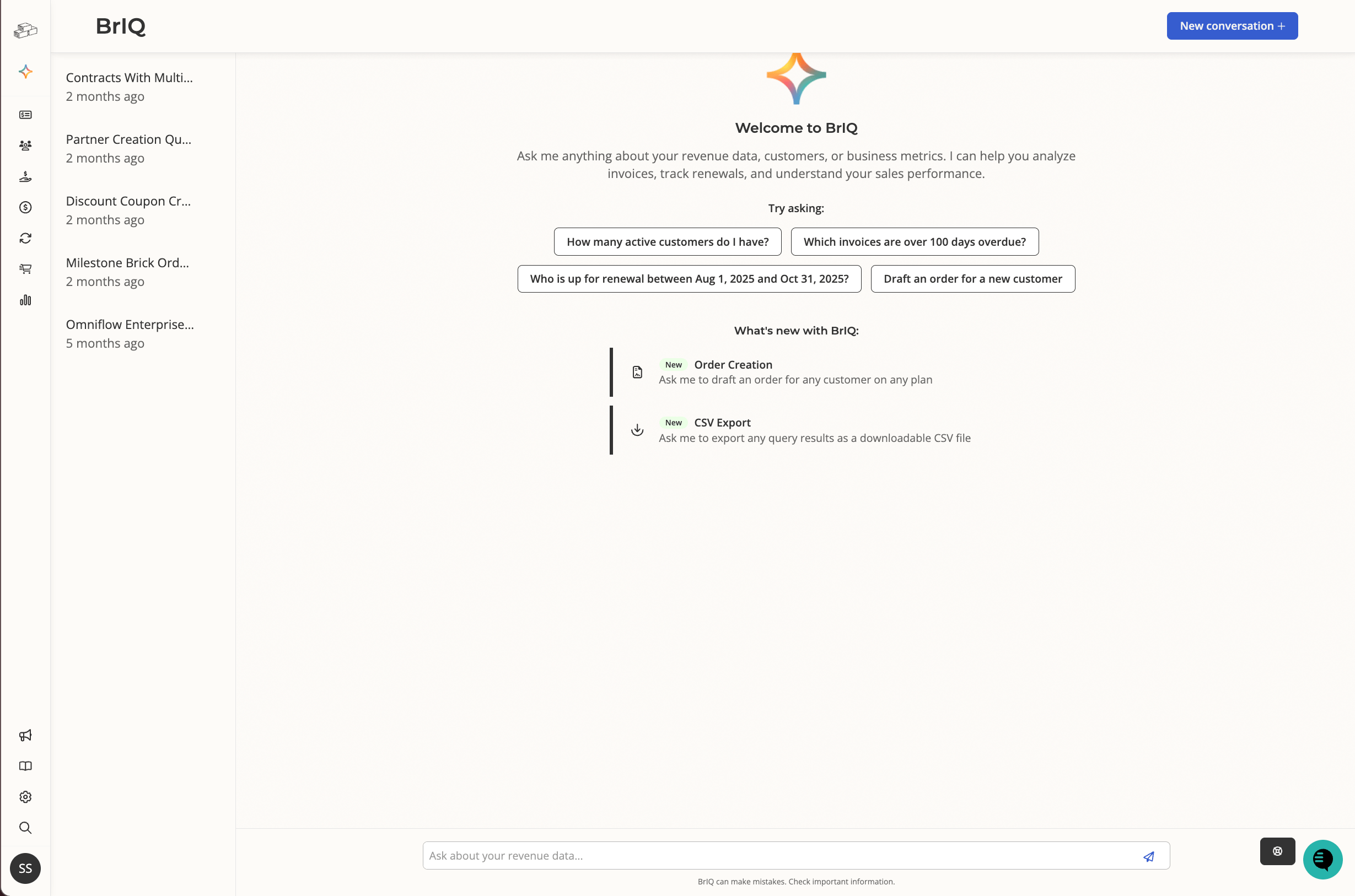
- Type your question in the input bar and press Enter.
- Click New conversation in the top-right corner to start a fresh chat at any time.
- Your previous conversations are listed in the left panel so you can return to them.
What you can ask BrIQ
BrIQ can answer a wide range of questions about invoices, customers, and revenue. Below are some common use cases with example prompts you can use as a starting point.Invoice tracking
Use BrIQ to quickly surface outstanding or overdue invoices — across all customers or for a specific one. Example prompts:- “Show me all past due invoices”
- “What are [Insert Company] outstanding invoices? Include the invoice number, amount due, due date, days past due, and payment link.”
- “Which customers have the most unpaid invoices?”
- “Show me invoices past due more than 90 days”
Revenue reporting
Ask BrIQ about revenue for a specific time period and it will return MRR totals, a customer-by-customer breakdown, and a narrative summary with key highlights. Example prompts:- “How much revenue was generated this month?”
- “Compare this month’s revenue to last month”
Customer billing history
Look up a specific customer’s billing picture without leaving the chat. Example prompts:- “Show all invoices for [Customer Name]”
- “What is [Customer]‘s renewal date and current spend?”
- “Pull all invoices for [Customer] including paid ones”
How Salesbricks works
Ask BrIQ how a feature works or where to find something, and it answers from the Salesbricks documentation and help articles. If BrIQ can do the task for you, it offers to. Example prompts:- “How do I set up dunning?”
- “What’s the difference between an upgrade and a recast?”
Drafting orders and catalog items
BrIQ can also do the work for you. Ask it to:- Draft a new order for any customer on any plan.
- Draft an upgrade, renewal, or recast of an existing subscription.
- Create bricks, products, and plans in your catalog.
- “Draft an order for a new customer”
- “Add 5 seats to [Customer]‘s subscription starting June 1”
How BrIQ presents answers
BrIQ formats its answers to be easy to scan and act on:- Tables — For invoice lists or revenue breakdowns, BrIQ organizes data into a structured table with relevant columns.
- Narrative summary — After any table, BrIQ provides a short written summary with key highlights (e.g., total billed, total collected, % paid).
- Direct links — BrIQ includes clickable links to customer pages, orders, and invoice payment pages within its responses.
- CSV export — Ask BrIQ to export any results as a downloadable CSV file.
- Suggested follow-ups — At the end of each response, BrIQ offers a few suggested next questions to help you keep exploring.
Build an order with BrIQ
If Create order opens the order builder without a BrIQ chat, the AI order builder isn’t enabled for your account yet. Reach out to us in your dedicated Slack channel.
1
Start an order
On the Orders page, click New order. In the Create order drawer, choose the customer, select New subscription or Migrating order, and click Create order.
2
Describe the deal
The order builder opens with BrIQ on the left and the order on the right. Tell BrIQ the plan and the terms, for example: “Pro plan, 25 seats, starting March 1, two-year term, billed annually on Net 30.”BrIQ creates the draft and the Order form tab fills in beside you as you go.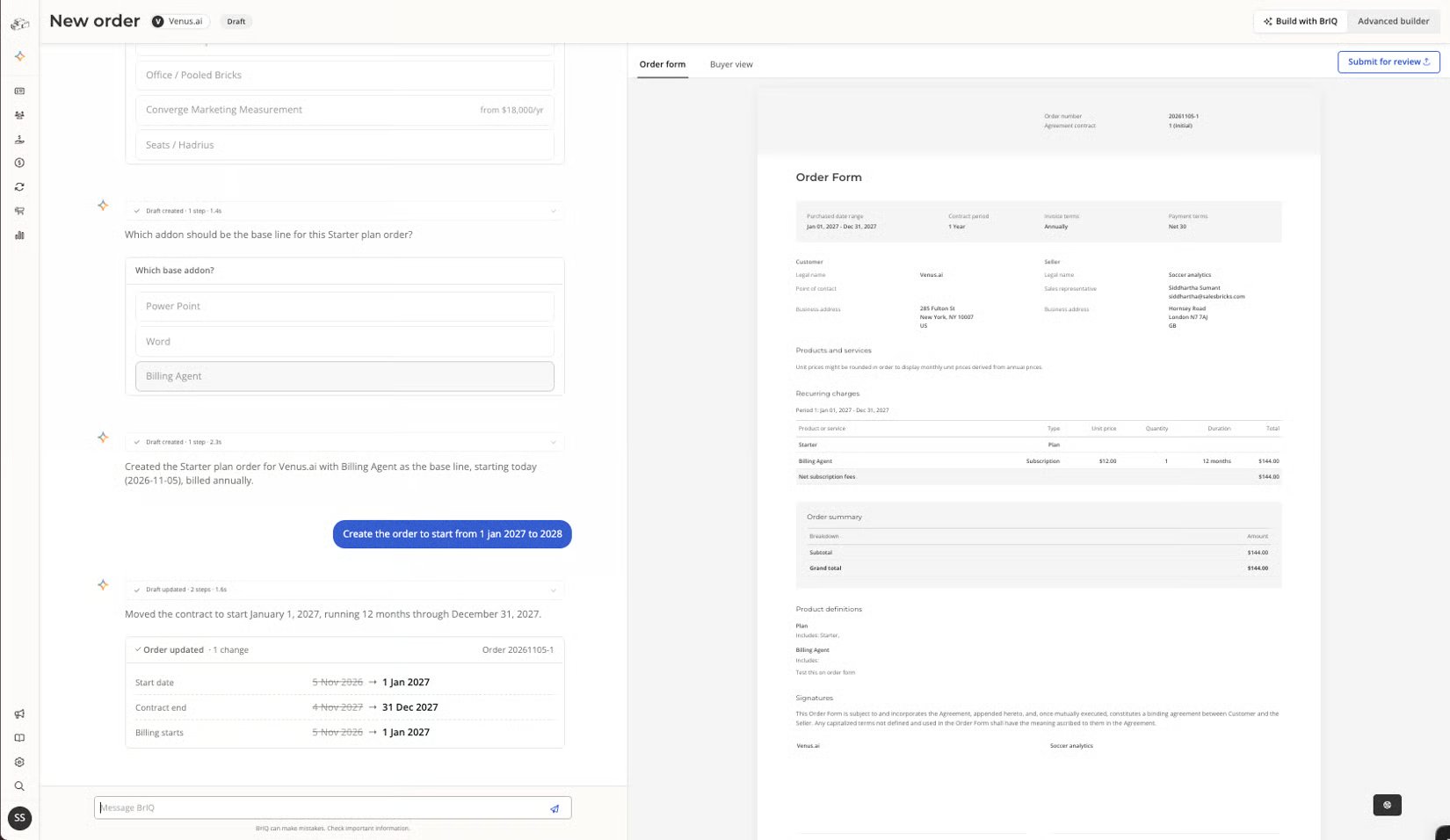
3
Review each change
BrIQ saves every change to the draft as it makes it. Under each reply, an Order updated card lists the fields that changed, with each old value beside its new one, and the changed parts of the order form are highlighted.
4
Check the buyer view
Click the Buyer view tab to see the checkout exactly as your customer will see it.
5
Share the order
Click Share order to send the order to your customer. If approval workflows are on, the button reads Submit for review until the order is approved.
What BrIQ can set
Describe the deal the way you’d explain it to a colleague. BrIQ handles plans and quantities, discounts, start dates and contract length, billing frequency and payment terms, ramps, and custom billing schedules. It also handles:- Phases: describe each stage of the deal, such as a three-month pilot followed by a two-year subscription, and BrIQ builds a phased order. For a few phase edits, such as on an order with a coupon, BrIQ points you to the Advanced builder.
- Quote expiry: tell BrIQ how long the quote stays open, for example “the quote expires on June 30,” and it sets Quote expires on.
- “Add a 10% discount on the platform fee”
- “Switch to monthly billing on Net 45”
- “Make the first three months free”
- “Ramp seats from 10 to 25 over the first year”
Edit a draft with BrIQ
To change an open order with BrIQ, open the order’s details page and click Edit with AI. The order builder opens on that order. BrIQ summarizes the plan and contract term, and you tell it what to change. Every change shows up in an Order updated card, just as when you build a new order.If approval workflows are on and the order is approved or pending review, BrIQ shows a notice before you start. Any change BrIQ makes moves the order back to draft, and you submit it for review again before you share it.
Update a subscription with BrIQ
If you don’t see BrIQ on the Update subscription page, it isn’t enabled for your account yet. Reach out to us in your dedicated Slack channel.
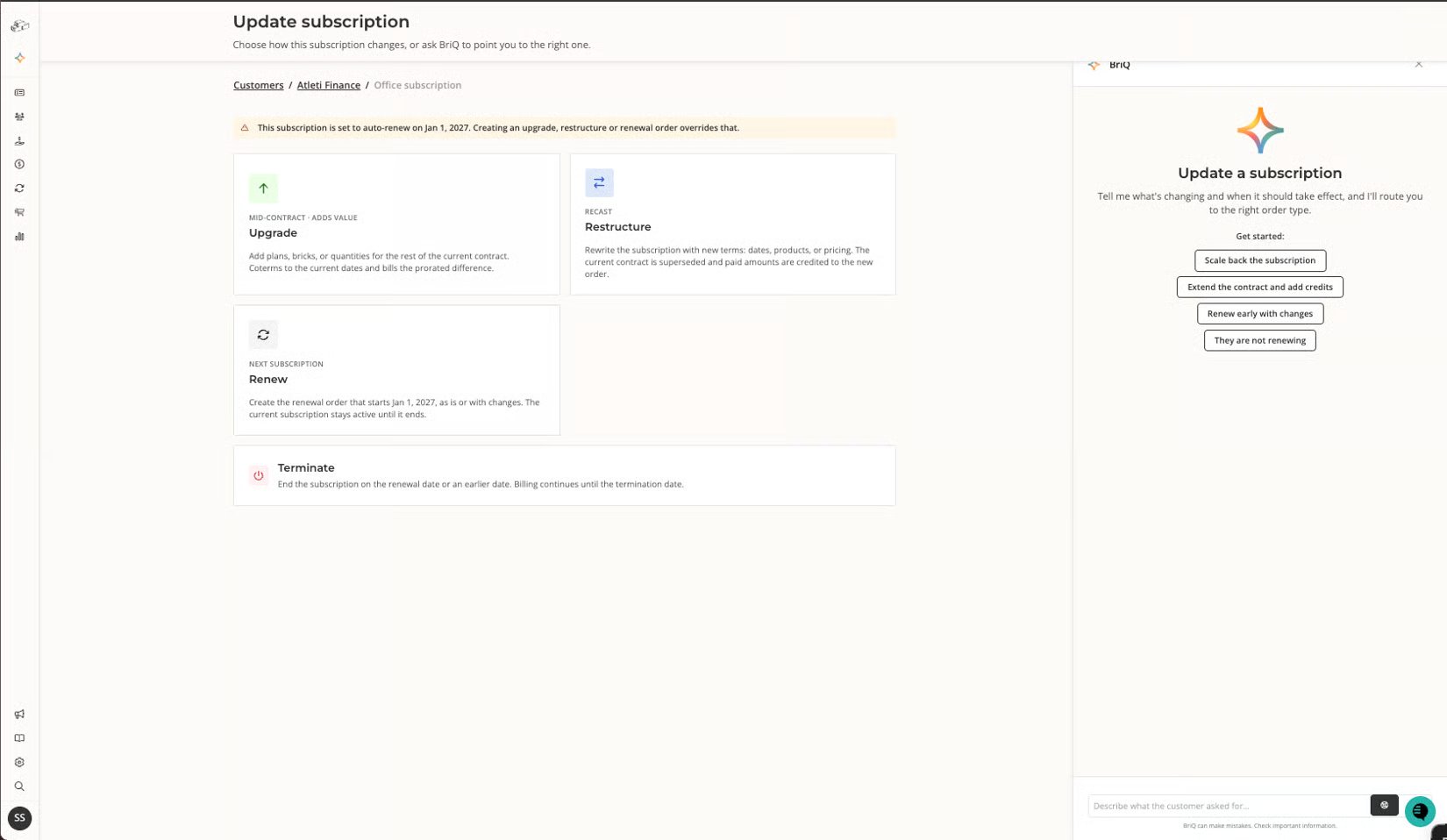
- Draft the upgrade (or downgrade, restructure, or renewal): BrIQ creates the draft order and opens it so you can review it and submit.
- I’ll build it myself: opens an empty draft of that type for you to fill in.
Tips for better results
Be specific about what you want. If you want a table in a specific format, say so. For example: “Show [Company]‘s outstanding invoices as a bulleted list with invoice number, amount due, due date, days past due, and payment link.” Use the customer’s exact name. If BrIQ doesn’t find a match, it may return no results or suggest similar names. Try the name exactly as it appears in Salesbricks. Ask follow-up questions. BrIQ remembers the context of your conversation. You can follow up with “Now show me the same for last month” or “Which of those are more than 60 days overdue?” without repeating yourself. Use the suggested prompts. After each response, BrIQ surfaces relevant follow-up questions. Clicking one of these is a quick way to drill deeper without typing. Give several changes at once. In the order builder, “Monthly billing, Net 45, two-year term” applies all three in one step.Where to finish in Salesbricks
BrIQ looks things up, drafts, and edits. These steps happen directly in Salesbricks:
BrIQ works with the data in your Salesbricks account. If BrIQ can’t answer your question, reach out to your dedicated Salesbricks support channel for help.
Have feedback on BrIQ? Let your Salesbricks team know in your dedicated Slack channel. We’re actively improving BrIQ based on how customers use it.